> By Sonu Kumar Suman · April 2, 2026 · 7 min read
A quiet revolution is underway in software engineering. It doesn't look like a single breakthrough model or a flashy demo. It looks like a team — except the teammates are AI agents, each with a precise role, collaborating at machine speed on the same complex task.
Welcome to the era of multi-agent AI networks.
> 📊 Gartner predicts a sharp and accelerating increase in the deployment of highly specialized AI agents working in coordinated networks across enterprise environments.
What Are Multi-Agent Networks?
Traditional AI assistants handle tasks end-to-end in a single conversation thread. Multi-agent networks are different: they deploy a network of specialized AI agents that each own a specific sub-task, then pass outputs to the next agent in the pipeline — much like a well-run engineering team.
Here's a real-world example: a company receives a bug report. Instead of one AI trying to understand the report, write a test, and fix the code all at once, a coordinated network handles it like this:
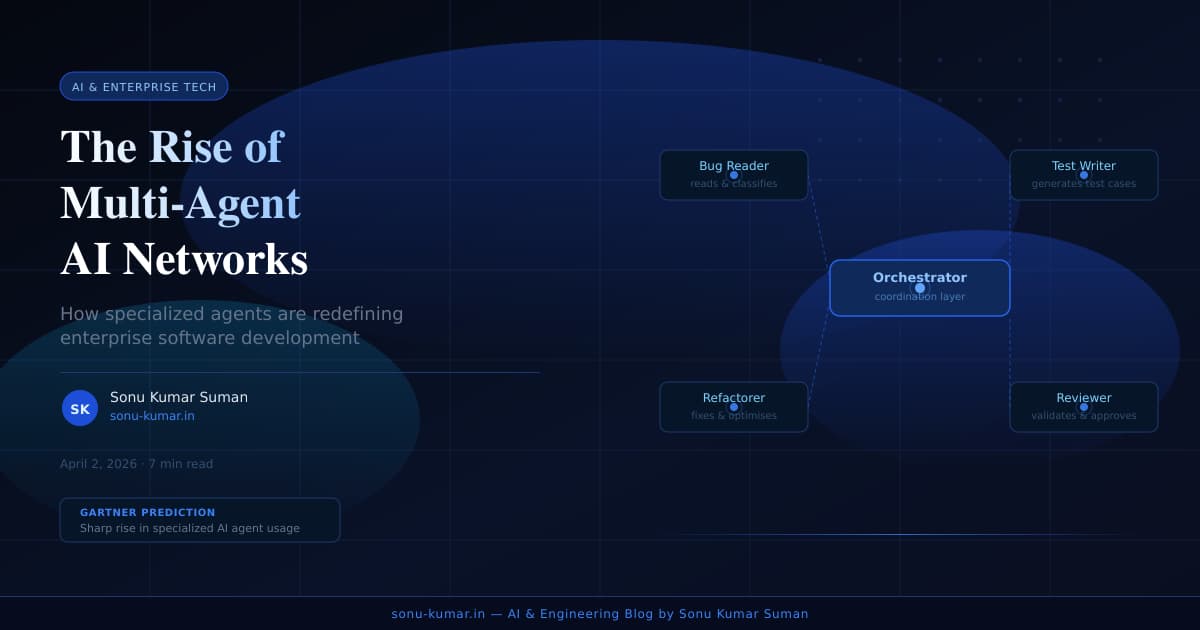
Bug Report ──► Agent 1 (Reader) ──► Agent 2 (Test Writer) ──► Agent 3 (Refactorer)
                     ▲                        ▲                        ▲
                     └────────────────────────┴────────────────────────┘
Orchestrator Layer- Agent 1 — Bug Report Reader: Parses, classifies, and summarises the issue. Extracts reproduction steps and assigns severity.
- Agent 2 — Test Writer: Receives the classified bug and generates failing unit tests that precisely capture the edge case.
- Agent 3 — Code Refactorer: Takes the failing tests, locates the root cause in the codebase, and patches it cleanly.
- Orchestrator: Manages the sequence, validates outputs at each step, and routes exceptions back for human review.
The result? A bug fix pipeline that runs faster than a human sprint cycle — and with auditable, step-by-step reasoning at every stage.
Why Specialization Matters
Generalist models are impressive. But specialization unlocks a different class of performance. Each agent in a network can be:
- Fine-tuned or prompted for its specific domain (security analysis, SQL generation, API documentation, etc.)
- Given only the tools and context it needs — reducing hallucination risk significantly
- Independently tested, monitored, and upgraded without touching the full pipeline
- Scaled independently — run 10 Test Writer agents in parallel without bottlenecking the Refactorer
This is the same reason microservices replaced monoliths in software architecture. The same principle now applies to AI systems.
What Gartner's Prediction Signals
Gartner's forecast of a sharp rise in specialized agent usage isn't just a trend observation — it's a signal about enterprise readiness. Companies are moving from:
> "We're experimenting with AI chatbots"
to:
> "We're deploying production-grade AI pipelines with defined roles, SLAs, and governance."
Industries already seeing early adoption:
Industry — Agent Use Cases
Software Development — Code review, test generation, PR summarisation
Legal & Compliance — Contract analysis, clause comparison, regulatory mapping
Customer Support — Intent routing, resolution drafting, escalation scoring
Finance — Anomaly detection, report generation, audit trail automation
Healthcare — Clinical note summarisation, triage assistance, prior auth drafts
Challenges You Should Know About
Multi-agent systems are powerful, but they introduce new complexity that teams must plan for:
1. Orchestration Overhead
Managing message passing, state, and failure handling between agents requires robust infrastructure. Tools like LangGraph, CrewAI, and AutoGen are emerging to address this — but they add a new layer to your stack.
2. Error Propagation
A wrong output from Agent 1 compounds by the time it reaches Agent 3. Validation checkpoints and confidence scoring at each handoff are essential — not optional.
3. Observability
You need logging and tracing at every agent boundary, not just at the final output. Think of it like distributed systems monitoring, applied to AI.
4. Cost at Scale
Each agent call carries latency and token cost. A 5-agent pipeline isn't 5× the cost of a single call — but optimizing the network is a discipline in itself.
What This Means for Developers and Teams
If you're an engineer or tech leader, the skills that matter next aren't just "how do I prompt an AI" — they're:
- System design for AI pipelines — clear contracts between agent steps
- Agent evaluation — how to test individual agents in isolation before wiring them together
- Human-in-the-loop design — where to place review gates and when to trust autonomous output
- Prompt architecture — writing system prompts that constrain agent scope without brittleness
The developer who combines software architecture intuition with AI orchestration knowledge will be extraordinarily valuable in the next wave of enterprise adoption.
Key Takeaways
- Multi-agent networks deploy teams of specialized AI agents, each owning a distinct sub-task
- Specialization reduces hallucination, enables independent scaling, and mirrors proven software architecture patterns
- Gartner's prediction reflects a real shift from AI experimentation to production-grade deployment
- Challenges include orchestration complexity, error propagation, observability, and cost management
- Engineers who understand both system design and AI will lead the next wave
Final Thoughts
Multi-agent AI networks aren't science fiction — they're entering production environments at companies right now. Gartner's prediction is less a prophecy and more a recognition of what's already happening at the frontier.
The real question isn't whether your organization will use specialized AI agents. It's how quickly you'll develop the architecture, culture, and tooling to deploy them well.
> 🌐 Enjoyed this post? Read more deep-dives on AI, software engineering, and the future of building at sonu-kumar.in — written by Sonu Kumar Suman. Subscribe for weekly insights delivered straight to your inbox.
Written by Sonu Kumar Suman · sonu-kumar.in · April 2, 2026